
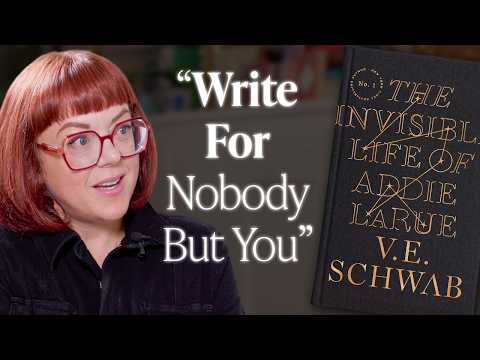
The Architecture of Great Writing (V. E. Schwab Interview)
V. E. Schwab argues great fiction is engineered: outline obsessively, start from the ending, invest slowly in character and rules, ground fantasy in reality, and write for yourself with patience.
Watch on YouTube ↗Charlie's summary
- ▶ 0:28
Build the whole book before drafting: outline in reader order, then write in each character's chronological order
Schwab separates narrative order (what the reader experiences) from chronological order (what each character experiences). She builds the book in narrative order, breaks it into chronological order to write each point-of-view character, then reassembles it. This helps her track the moral decay of three women across 300 years in Bury Our Bones. Her play is the months or years of outlining, because the first draft is “an exercise in control failure.”
- ▶ 3:29
Start every story with the ending, then collect ingredients until the meal is ready
Schwab starts with the ending, “the taste left in your mouth at the end of the meal,” then rewinds to find the beginning. Ideas can sit for one to two years until a missing ingredient arrives, as with a middle-grade idea that clicked after a year. Her rule: never design sets you won't use. Every world-building element must tether to plot or character, like anime that drops you in and lets you infer the rules.
- ▶ 9:38
Slow beginnings are an investment: the first 100 pages earn the ending's impact
Schwab was dinged for slow openings in many of her 27 books, then decided it is “a feature, not a bug.” You must learn the game board and rules before you can care about the outcome, and readers love her endings because of that early investment. She tries to “bury the broccoli in the mac and cheese,” hiding exposition in a slow-burn plot. Starting at the top of the drop leaves characters second and nowhere to go but down.
- ▶ 18:16
Build characters from backstory: know the formative highs and lows and the hills they will die on
Schwab builds characters as real people whose existence doesn't depend on the reader's attention. She wants the highlights and low lights that shaped them, not a David Copperfield biography. Formative moments needn't be trauma. Her tip is to read memoir, which shows people choosing their own defining moments. Once you know what made someone who they are, you can roll them forward into new crossroads.
Give your email to unlock the rest of the key points — for every episode.
Do more with Charlie
Free — sign in with your email, no password.